People who stay
Living at the poles
The people who work at the poles live and work in some of the strangest buildings on Earth. Here are three, from the organisations that run them.
Halley VI: a research station that walks
The British Antarctic Survey’s Halley VI sits on the floating Brunt Ice Shelf in the Weddell Sea, at 75°34′S, 26°34′W, on ice that the Survey describes as 150 m thick and continually moving. [British Antarctic Survey] A building on a moving, cracking shelf of floating ice needs a trick, and Halley has one. It is, the Survey says, “the world’s first relocatable research facility”: eight modules on hydraulic legs and skis. [British Antarctic Survey] The legs can be raised so it is not buried by snow, and the whole station can be moved “if a crack in the ice shelf threatens its stability.” [British Antarctic Survey]
That happened. In 2017, the Survey says, Antarctica’s first relocatable research station was moved successfully 23 km inland to avoid the path of large cracks in the ice. [British Antarctic Survey] A Survey news item on the move says operational teams spent 13 weeks moving the modules. [British Antarctic Survey] Another reports that after a calving, the ice was moving about 4 metres a day towards the sea, against an average of 1 to 2.5 metres a day before. [British Antarctic Survey]
Where the ozone hole was found
Halley’s most famous result came out of a long, patient record. Ozone has been measured there since 1956, and in 1985 British scientists used that data to discover the hole in the ozone layer. [British Antarctic Survey] The discovery led to the Montreal Protocol, the international agreement banning ozone-depleting chlorofluorocarbons, or CFCs. [British Antarctic Survey] Forty years later, the Survey says, the ozone hole is much reduced, but the healing is very slow. [British Antarctic Survey] Halley is still one of the 30 stations in the World Meteorological Organization’s Global Atmosphere Watch programme. [British Antarctic Survey]
Concordia: further than the space station
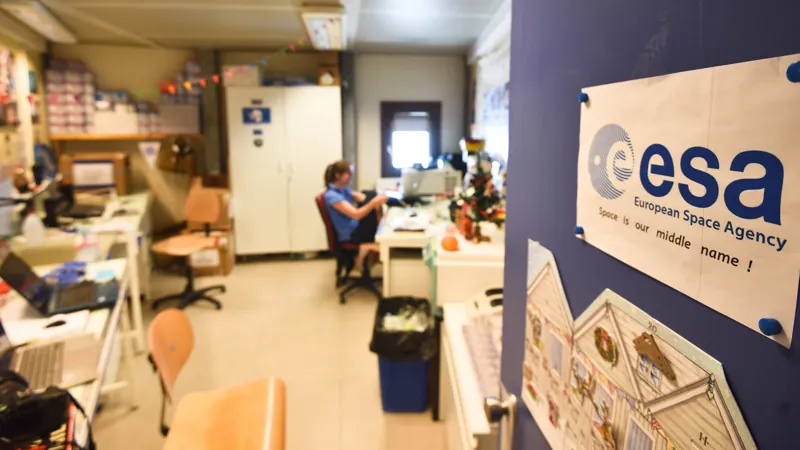
Concordia station came from a joint wish by Italy and France to build a permanent Antarctic research base together. [ESA] It stands on a plateau 3,200 m above sea level, and the European Space Agency describes it as one of the remotest places on Earth. [ESA] Temperatures can drop to −80 °C in winter, with a yearly average of −50 °C. [ESA]
It is so cut off that ESA uses it as a stand-in for space. “The voyage to Concordia station, one of the remotest places on Earth, takes longer than the voyage to the International Space Station,” ESA says. [ESA] For two decades ESA has sent a medical doctor to spend 13 months there, studying how isolation affects people so that scientists can develop countermeasures for future missions beyond Earth. [ESA] Halley’s teams have worked with Concordia on one such study, using a cockpit simulator built to train astronauts to dock at the International Space Station, to see how well people keep those skills through long periods of darkness and isolation. [British Antarctic Survey]
Port Lockroy: the base that became a post office
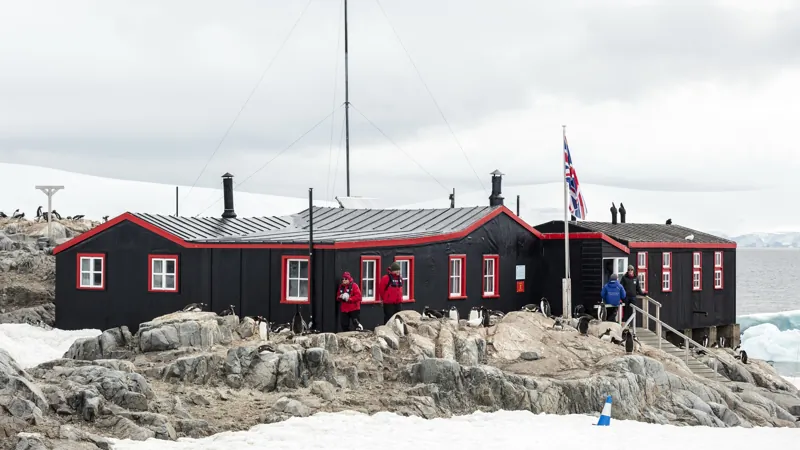
Port Lockroy, on Goudier Island off the Antarctic Peninsula, was a safe anchorage for whaling fleets in the early 20th century. [UK Antarctic Heritage Trust] On 11 February 1944 it became Base A, set up under a secret wartime mission, Operation Tabarin, to establish a permanent British presence in Antarctica. [UK Antarctic Heritage Trust] It was the first of those bases and, the UK Antarctic Heritage Trust says, became the birthplace of the British Antarctic Survey. [UK Antarctic Heritage Trust] From 1945 it was run as an atmospheric science base and a wireless hub for bases further south, until January 1962. [UK Antarctic Heritage Trust]
Since November 1996 the base has been a historic site and museum. The largest of its three buildings, Bransfield House, holds a museum, a post office and a shop, and the proceeds pay for running Port Lockroy and help look after other British historic sites in Antarctica. [UK Antarctic Heritage Trust] The Trust took full responsibility in 2006 and welcomes up to 18,000 visitors a season; the harbour, it says, has become the most popular visitor destination in Antarctica. [UK Antarctic Heritage Trust]
The rules everybody lives by
Every one of these stations operates under the Antarctic Treaty, signed in 1959, which reserves the continent for peaceful purposes and science and says that all stations, installations and equipment “shall be open at all times to inspection”. [Antarctic Treaty Secretariat] More on the treaty on polar explorers.
Small print: the Halley figures here are from the Survey’s station page, which collects news items from different years; the 4 metres a day was reported after a calving, and the 2017 move is the Survey’s own description. [British Antarctic Survey] Concordia’s temperatures and height are from ESA’s Concordia pages. [ESA]
Enjoyed a desk of official cold records, ice caps, and a night that lasts a season?
No pop-ups. No intrusive advertising. Just interesting stuff. A little support helps the next climates.im site get built.