The official records
The coldest place, and more than one official thermometer.
The WMO’s world air-temperature record is −89.2 °C at Vostok on 21 July 1983. NASA’s 2013 satellite work, and a later NSIDC revision, give colder land-surface figures. They stay in the same room, and they are not averaged.
One place, several official thermometers, and a careful refusal to average them.
A desk of official low-temperature records
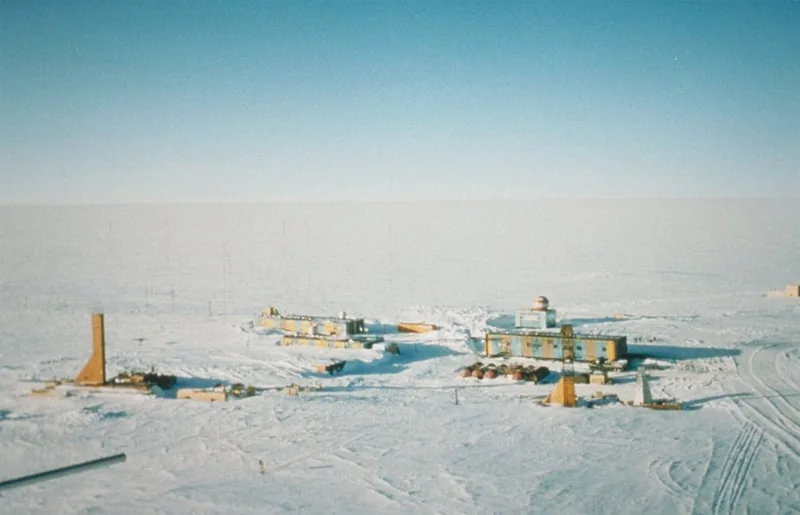
The WMO’s World Weather and Climate Extremes Archive gives the world’s lowest temperature as −89.2 °C (−128.6 °F) at Vostok, Antarctica, on 21 July 1983, at 77°32′S, 106°40′E, elevation 3,420 m (11,220 ft). The instrument was a maximum/minimum thermometer in a standard Stevenson screen. The record had a formal WMO review in 2011. [source] [source]
The same official Vostok page is honest about a figure you may still meet in older tables. Cerveny and colleagues, quoting Krause and Flood, gave −89.4 °C. Stephen Warren photographed the station’s monthly-summary logbook in January 1991; the reported value is −89.2 °C. The error, the WMO page says, was probably a conversion to Fahrenheit, rounding to −129 °F, and a conversion back. [source] This desk uses −89.2 °C, and treats −89.4 °C as a discarded conversion, not as a second record.
NASA, in a 9 December 2013 release on Landsat 8 and other satellite maps, described something different: land-surface temperatures in hollows on a high ridge of the East Antarctic Plateau, between Dome Argus and Dome Fuji, that can dip below minus 133.6 degrees Fahrenheit (minus 92 degrees Celsius) on a clear winter night. “The new record of minus 136 F (minus 93.2 C) was set Aug. 10, 2010.” [source] That is a skin temperature read from space, not a Stevenson-screen reading at Vostok.
NSIDC later described a revision of that satellite work, “showing that the coldest sites actually reach −98 degrees Celsius.” [source] The 2013 NASA wording is not quietly overwritten here. Both official accounts stay, dated, on the desk.
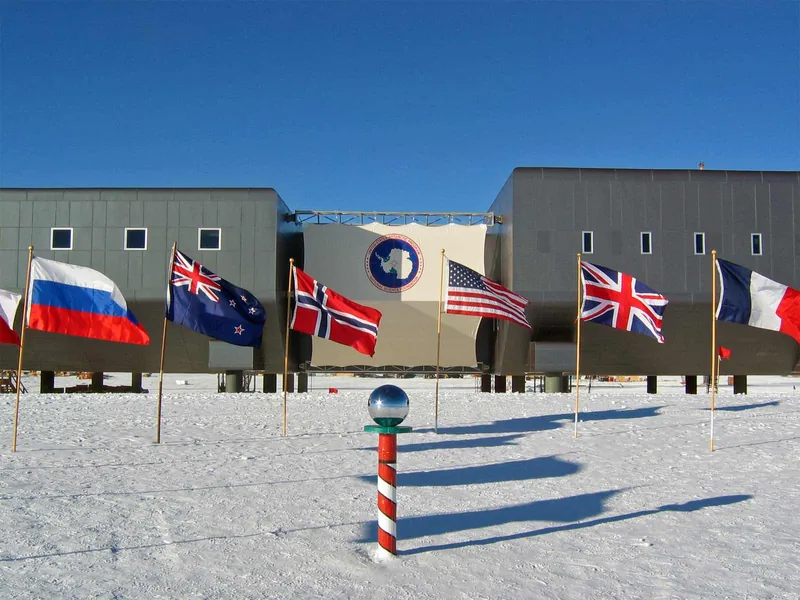
The Northern Hemisphere has its own official record, and it is not close to Vostok. The WMO has recognised −69.6 °C (−93.3 °F) at an automatic weather station in Greenland on 22 December 1991 as the lowest recorded there, eclipsing −67.8 °C at Verkhoyansk in February 1892 and at Oimekon in January 1933. The same announcement restates the world record as −89.2 °C on 21 July 1983 at high-altitude Vostok. [source]
Enjoyed a desk of official cold records, ice caps, and a night that lasts a season?
No pop-ups. No intrusive advertising. Just interesting stuff. A little support helps the next climates.im site get built.