Who lives here
Polar animals
The two poles have almost no animals in common. The Arctic has bears, the Antarctic has penguins, and both are fed, in the end, by the sea. Here is who lives at each end, in the words of the people who count them.
The Arctic: a bear that lives on the sea
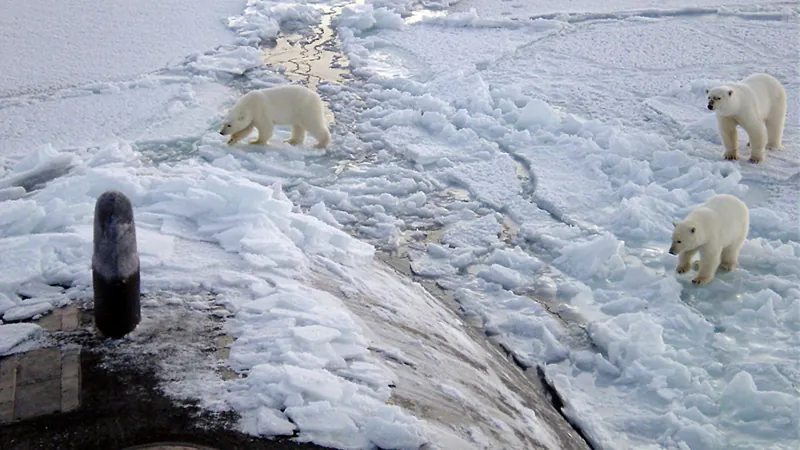
The polar bear is a sea animal that happens to walk. The US Fish and Wildlife Service says it is “largely dependent on sea ice”, with a native range across the circumpolar Arctic, mostly above the Arctic Circle, “one of the largest ranges for an extant large carnivore”. [US Fish and Wildlife Service] Its scientific name is Ursus maritimus, and the same official page lists “White Bear” as another common name. [US Fish and Wildlife Service]
There are not many of them. The service gives a global estimate of 26,000 polar bears as of 2023, living in 19 subpopulations in the ice-covered waters of Canada, Greenland, Norway, Russia and the United States. [US Fish and Wildlife Service] The US has parts of two: the Chukchi Sea and the Southern Beaufort Sea. [US Fish and Wildlife Service]
They are also younger than you might think. Genetic research, the service says, has confirmed that polar bears evolved from brown bears roughly 500,000 years ago, and the two still overlap in northern Canada, Alaska and eastern Russia. [US Fish and Wildlife Service]
A polar bear’s menu is short. It hunts ringed seals above all, and bearded seals to a lesser extent, and now and then takes a walrus or a beluga. In some places, including the Southern Beaufort Sea, Svalbard and Chukotka, the remains of bowhead whales from subsistence hunts, strandings or orca kills are an important seasonal meal. [US Fish and Wildlife Service]
Only the mothers go to bed
Black bears and brown bears of every age and sex spend several winter months asleep in a den. Polar bears do not. The Fish and Wildlife Service is precise: “only pregnant female polar bears overwinter in dens.” [US Fish and Wildlife Service] Females go into their dens between September and December, and the cubs usually stay with their mother until they are two. That means a successful mother can have cubs at most once every three years, part of what the service calls a “low reproductive rate”. [US Fish and Wildlife Service]
The Antarctic: two true natives
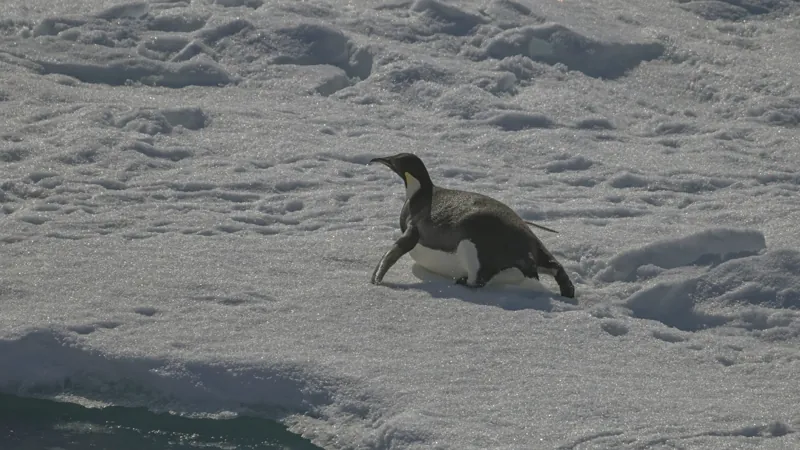
The British Antarctic Survey counts six major penguin species in the Antarctic, but only two, the emperor and the Adélie, are “truly native to the continent itself”. Macaroni, chinstrap, gentoo and king penguins live on the warmer sub-Antarctic islands. [British Antarctic Survey]
The emperor is the largest, and it does everything the hard way. It breeds in the coldest, darkest winter months. The female lays a single egg, and the male incubates it for nine weeks without eating, living on his fat. [British Antarctic Survey] The Adélie, smaller, spends the winter out in the pack ice and comes to the coast in summer for a short, busy breeding season. [British Antarctic Survey]
A long way from each other
So the polar bear and the penguin, so often drawn side by side, live at opposite ends of the planet. The bear’s range is the circumpolar Arctic; the two truly native penguins belong to the Antarctic continent. [US Fish and Wildlife Service] [British Antarctic Survey]
The bird that goes to both
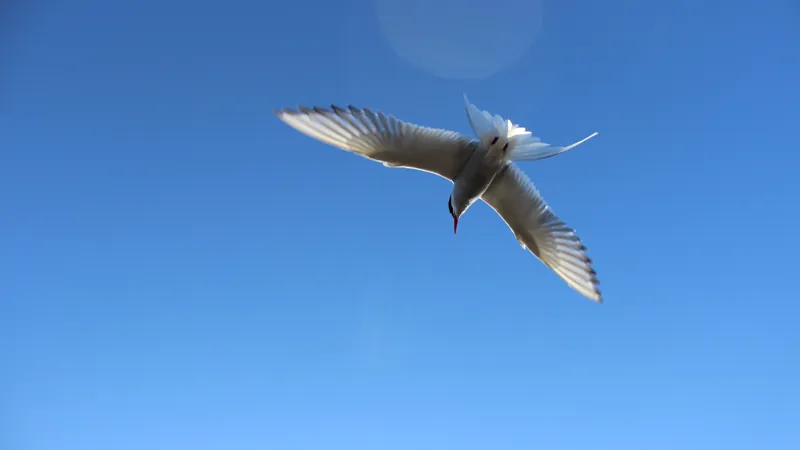
One animal does visit both ends. Audubon’s field guide calls the Arctic tern “famous as a long-distance champion”: some may migrate farther than any other birds, from the high Arctic to the Antarctic. [Audubon] Its migrations take it to every ocean and near every continent. It breeds on coasts and tundra from New England, Washington and Britain north to the northernmost land, and spends the rest of the year at sea, mostly over cold water well offshore. [Audubon] It usually breeds for the first time at three or four years old. [Audubon]
The animal at the bottom of everything
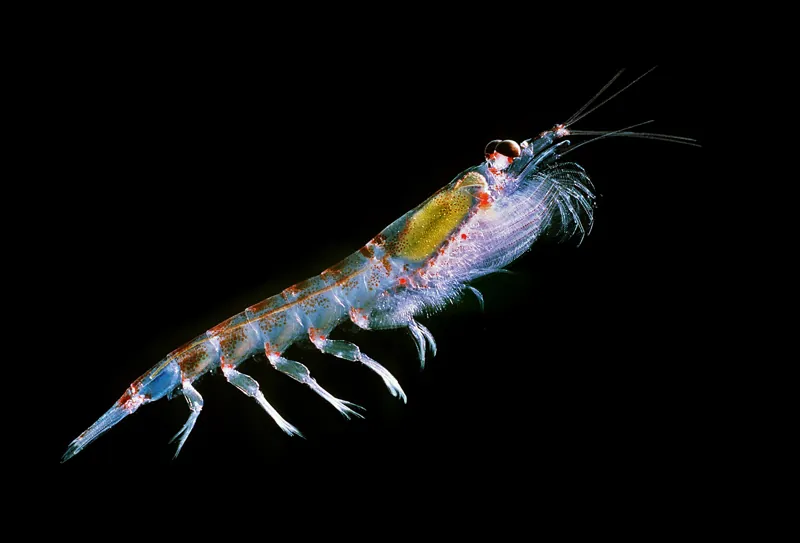
The Southern Ocean food web is, in the British Antarctic Survey’s words, relatively simple, and at its base is Antarctic krill: “a small shrimp-like crustacean that is a food source for most of the larger animals in the region.” [British Antarctic Survey] Krill live in dense swarms. Because so much depends on them, there are international efforts to manage the modern krill fishery. [British Antarctic Survey]
The great whales depend on one of the smallest animals in the sea. Baleen whales such as blue whales and humpbacks eat krill, filtering them from seawater through a bony mesh, the baleen. Toothed whales such as orcas eat fish, squid, penguins and seals. [British Antarctic Survey]
A fish with clear blood
The fish of the Southern Ocean have had to solve a problem no other fish has: water that is always close to freezing. The British Antarctic Survey says many carry a natural antifreeze, glycoproteins in their blood that stop them freezing. [British Antarctic Survey] The icefish goes further. It “lacks red blood cells and transports oxygen through its blood plasma.” [British Antarctic Survey]
Seals: solitary, social and enormous
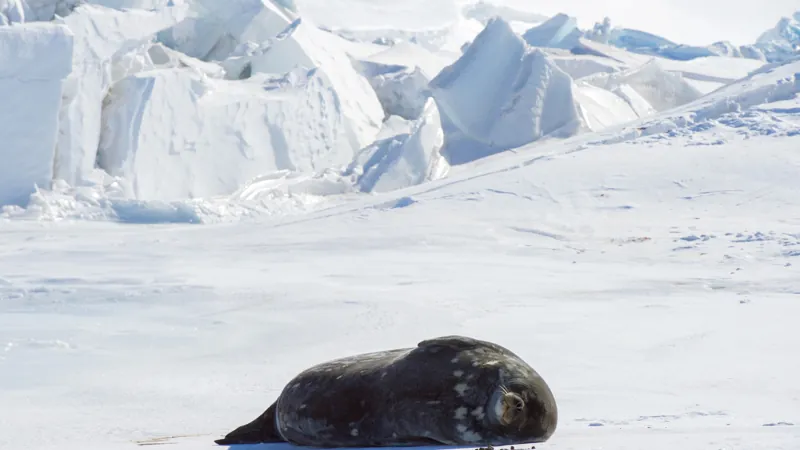
Seals are, the Survey says, a significant part of the Antarctic ecosystem. The species include the solitary leopard seal, the social Weddell seal and the large elephant seals. [British Antarctic Survey] Like the whales, they were once heavily hunted and are now largely protected. [British Antarctic Survey]
The biggest animal on land is 2 mm long
On the continent itself, life is sparse. There are no naturally occurring land mammals, reptiles or amphibians, though there are earthworms, molluscs and some insects. [British Antarctic Survey] The British Antarctic Survey singles out the flea-like Antarctic springtail, only 1 or 2 mm long, with its own natural antifreeze. Weighing only a few micrograms, it is, the Survey says, one of the largest animals to complete its whole life cycle on the Antarctic continent. [British Antarctic Survey] In the most extreme cold deserts, a few species of nematode worm are among the only life there is. [British Antarctic Survey]
Two flowers
Less than 1% of Antarctica is free of ice. That small patch supports exactly two species of flowering plant: Antarctic hair grass and Antarctic pearlwort. [British Antarctic Survey] Most of the rest of the plant life is mosses, liverworts and lichens. The milder sub-Antarctic islands have a richer mix, including tussock grass. [British Antarctic Survey]
Two poles, two kinds of life: the Arctic is an ocean surrounded by land, and its top predator walks on the sea ice. The Antarctic is a continent surrounded by ocean, and almost all its animals live in or around the water. [NSIDC] [British Antarctic Survey]
Enjoyed a desk of official cold records, ice caps, and a night that lasts a season?
No pop-ups. No intrusive advertising. Just interesting stuff. A little support helps the next climates.im site get built.