People who went first
Polar explorers
A century ago, the poles were the last blank spaces on the map, and people raced to fill them in. Here is what the museums and archives that look after their stories say happened, including where they disagree.
The man who changed direction
Roald Amundsen had meant to go north. The Scott Polar Research Institute explains that when both Robert Peary and Frederick Cook announced in 1909 that they had reached the North Pole, and Amundsen feared the Arctic voyage he had in mind would not raise enough money, he decided to go for the South Pole instead. [Scott Polar Research Institute] He said he decided before Captain Scott announced his own Terra Nova expedition, but he kept it secret until after he had left Norway. [Scott Polar Research Institute] Royal Museums Greenwich puts it more simply: he changed his mission on hearing the North Pole had been reached. [Royal Museums Greenwich]
The race
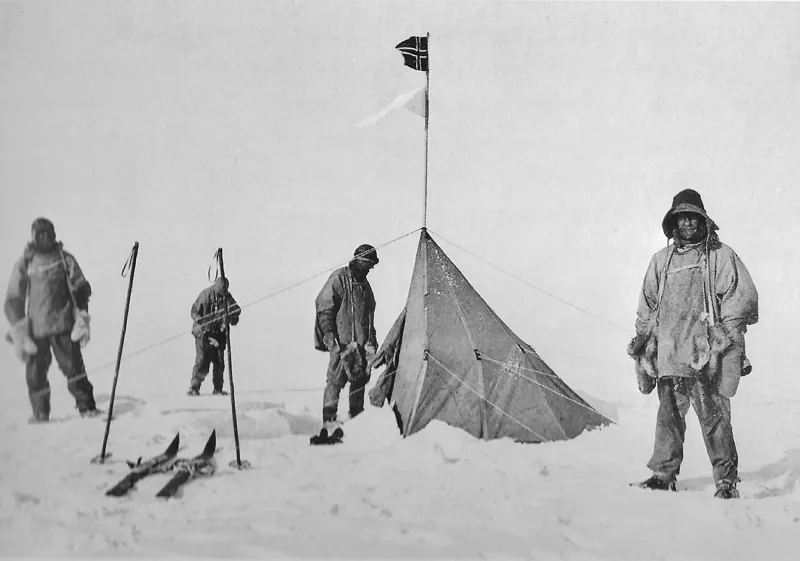
Amundsen’s ship Fram reached the Ross Ice Shelf on 14 January 1911, and he chose to land at the Bay of Whales, which Royal Museums Greenwich says gave the Norwegians a 60-mile advantage over Scott, who landed at McMurdo Sound. [Royal Museums Greenwich] After the Antarctic winter, Amundsen’s team set off for the Pole on 18 October 1911; Scott began his trek about three weeks later. [Royal Museums Greenwich]
At around 3 pm on 14 December 1911, Amundsen raised the Norwegian flag at the South Pole. [Royal Museums Greenwich] The Norwegians were back at base camp on 25 January 1912, 99 days and roughly 1,400 nautical miles after leaving it. [Royal Museums Greenwich]
Scott and four companions reached the Pole and found the Norwegians had beaten them by 34 days, in the University of Cambridge’s account. [University of Cambridge] The whole of Scott’s party died on the way back. Some of their bodies, journals and belongings were found by a search party eight months later. [University of Cambridge] Scott’s last diary entry, Royal Museums Greenwich says, is dated 29 March 1912; he died in his tent alongside two of his men. [Royal Museums Greenwich]
Which day? The Scott Polar Research Institute and the University of Cambridge give Scott’s arrival at the Pole as 17 January 1912. [Scott Polar Research Institute] [University of Cambridge] Royal Museums Greenwich says 18 January 1912. [Royal Museums Greenwich] The photograph above is dated 18 January on its Commons file, but with the year given as 1911. We give both days and leave the year at 1912.
Photographs printed in Antarctica
Scott took a camera. In 2012 the Scott Polar Research Institute bought 109 photographs from his last expedition, which give “a view of the Antarctic as seen through Captain Scott’s eyes” on the first part of his journey to the Pole. [University of Cambridge] They were printed in the Antarctic by members of his team as they waited for him to come back, and for most of the previous 70 years they were thought to be lost. [University of Cambridge] The purchase reunited them with Scott’s camera, which Lady Philippa Scott had given to the Institute in 2008. [University of Cambridge]
Amundsen’s other firsts
The South Pole was only one entry on Amundsen’s list. The Scott Polar Research Institute credits him with the first Antarctic over-wintering, on the Belgica; the first transit of the Northwest Passage, in his small boat Gjøa between 1903 and 1906, “achieving a goal that had evaded other sailors for centuries”; and a circumnavigation of the Arctic on the Maud. [Scott Polar Research Institute] In 1926 he and Lincoln Ellsworth flew across the Arctic in the airship Norge, Italian-built and piloted by Umberto Nobile. Richard Byrd claimed to have reached the North Pole first, but the Institute says “there is no doubt that the airship did reach the Pole”. [Scott Polar Research Institute] In 1928 Amundsen and his crew disappeared on the Latham 47. [Scott Polar Research Institute]
Shackleton’s ship, found
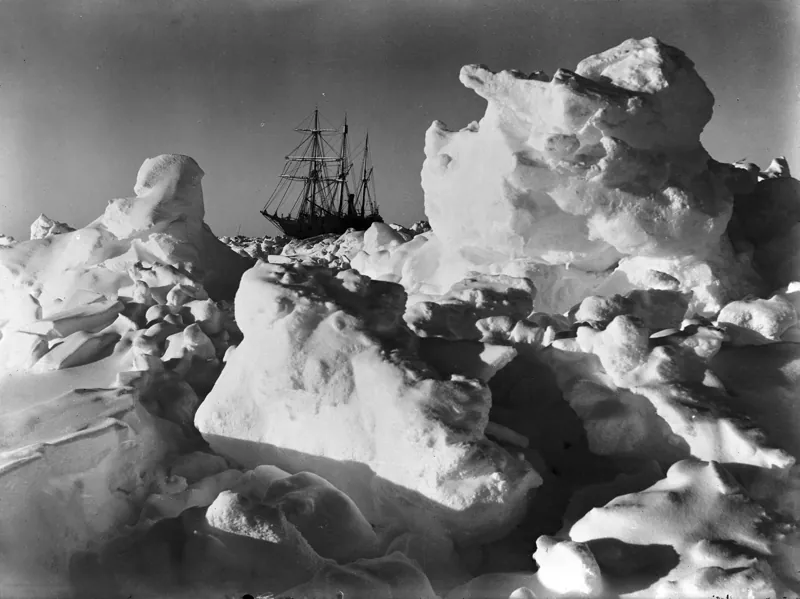
Sir Ernest Shackleton’s ship Endurance was crushed by the ice and sank in the Weddell Sea in 1915, and had not been seen since, the Falklands Maritime Heritage Trust says. Its captain, Frank Worsley, recorded the position. [Endurance22]
In March 2022 the Falklands Maritime Heritage Trust announced that its Endurance22 expedition had found the wreck “at a depth of 3008 metres in the Weddell Sea”, inside the search area the team had defined before leaving Cape Town, and about four miles south of Worsley’s position. [Endurance22] The search worked from the South African polar vessel S.A. Agulhas II, under its master, Captain Knowledge Bengu, using Saab Sabertooth underwater vehicles. [Endurance22] The Trust paid tribute to Worsley, “whose detailed records were invaluable in our quest to locate the wreck.” [Endurance22]
The wreck is protected as a Historic Site and Monument under the Antarctic Treaty, so that while it is surveyed and filmed it “will not be touched or disturbed in any way.” [Endurance22]
A treaty for a whole continent
Today the continent is governed by an agreement. The Antarctic Treaty was signed in Washington on 1 December 1959 by the twelve countries whose scientists had been active in and around Antarctica during the International Geophysical Year of 1957–58. It came into force in 1961, and there are now 58 Parties. [Antarctic Treaty Secretariat]
Its first articles say Antarctica shall be used for peaceful purposes only, that freedom of scientific investigation shall continue, and that scientific results shall be exchanged and made freely available. [Antarctic Treaty Secretariat] Seven of the signatories, Argentina, Australia, Chile, France, New Zealand, Norway and the United Kingdom, have territorial claims, some overlapping; other countries do not recognise any claims. Article IV freezes the question: no new claim, or enlargement of an existing one, can be made while the treaty is in force. [Antarctic Treaty Secretariat] And every station, the treaty says, “shall be open at all times to inspection”. [Antarctic Treaty Secretariat]
Enjoyed a desk of official cold records, ice caps, and a night that lasts a season?
No pop-ups. No intrusive advertising. Just interesting stuff. A little support helps the next climates.im site get built.