Look up
Polar skies
The polar sky does two famous things: it stays light all night in summer and dark all day in winter, and it lights up green. The first is on the light page. This page is about the second.
What the aurora is
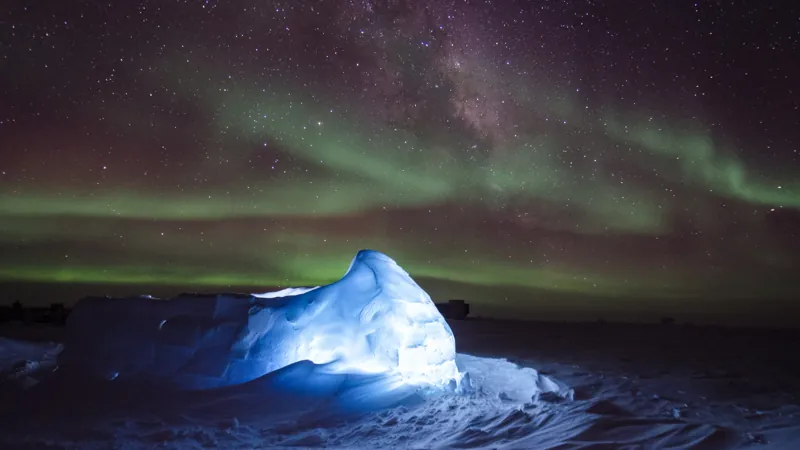
NOAA’s Space Weather Prediction Center explains that the aurora borealis, the northern lights, and the aurora australis, the southern lights, are “the result of electrons colliding with the upper reaches of Earth’s atmosphere.” [NOAA SWPC] Protons make aurora too, but it is faint and diffuse and usually hard to see. [NOAA SWPC]
The electrons are energised on the night side of Earth’s magnetic bubble, the magnetosphere, and follow the magnetic field down towards the polar regions. There they hit oxygen and nitrogen in the upper atmosphere and give it energy, which comes back out as light. NOAA compares it to how a neon light works. [NOAA SWPC]
Two rings of light
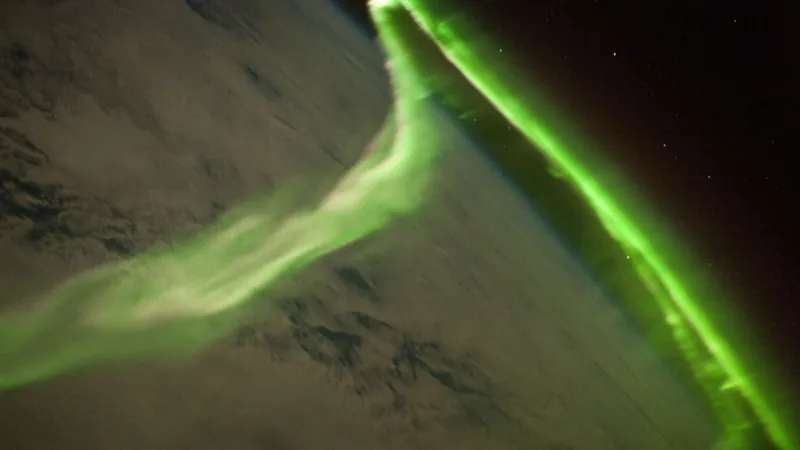
The aurora typically forms 80 to 500 km above Earth’s surface. [NOAA SWPC] Earth’s magnetic field steers the electrons so that the aurora makes two ovals, roughly centred on the magnetic poles. In major geomagnetic storms the ovals grow away from the poles, and the aurora can be seen over most of the United States. [NOAA SWPC]
The best place to watch, NOAA says, is under those ovals, between latitudes of about 60 and 75 degrees north or south. There, the aurora can be seen on more than half the nights of the year. [NOAA SWPC] During large events it reaches as far as the US, Europe and Asia, and during very large ones even further from the poles. [NOAA SWPC]
Curtains, arcs and substorms
NOAA describes the aurora’s night like a play in acts. Often it is made of tall rays “that look much like a curtain made of folds of cloth.” In the evening the rays can form arcs from horizon to horizon. Near midnight the arcs often begin to twist and sway “as if a wind were blowing on the curtains of light.” They may then fill the whole sky, moving fast and becoming very bright: the peak of an auroral substorm. Towards morning the aurora can turn into cloud-like patches that blink on and off for hours, then fade as the sun rises. [NOAA SWPC]
When to look
NOAA’s viewing tips say the best aurora is usually within an hour or two of midnight, between 10 pm and 2 am local time, and that the active hours spread into the evening and morning as geomagnetic activity rises. [NOAA SWPC] The best seasons are around the spring and autumn equinoxes, when, “due to subtleties in the way the solar wind interacts with Earth’s magnetosphere”, larger geomagnetic storms tend to happen. [NOAA SWPC] A full moon makes the aurora look fainter, though it does not change how bright it really is. [NOAA SWPC]
The midnight sun gets in the way
There is a polar catch. To see the aurora the sky must be clear and dark, so during the summer months at auroral latitudes, NOAA says, “the midnight sun prevents auroral observations.” [NOAA SWPC] At the South Pole, the National Science Foundation caption on the light page says the aurora australis dances through the sky virtually all the time during the long winter night. In other words, the poles have the best aurora in the world, and for half the year nobody can see it.
Two different poles: the aurora’s ovals are centred on the magnetic poles, not the geographic ones that Amundsen and Scott raced to. [NOAA SWPC] That is why the best aurora watching is a belt of latitude, not the Pole itself.
Enjoyed a desk of official cold records, ice caps, and a night that lasts a season?
No pop-ups. No intrusive advertising. Just interesting stuff. A little support helps the next climates.im site get built.